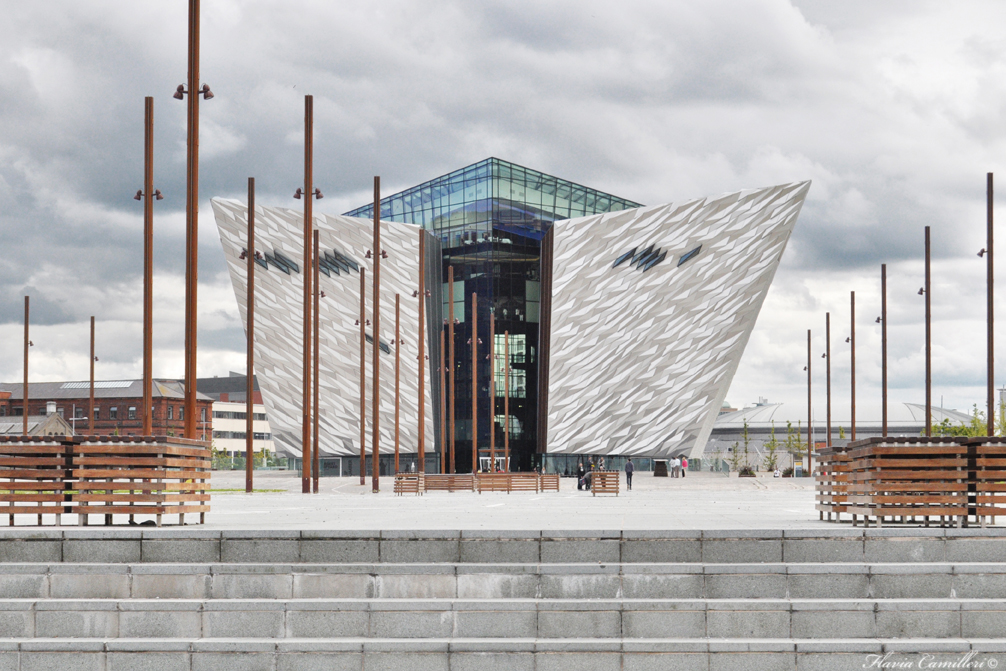
On 31st March 2012, 100 years after the sinking of the Titanic, the Titanic Belfast was opened, on the heads of the historical Olympic's and Titanic's slipways.
The Titanic Belfast was part of the reinvention of the site which began with the new millennium and was also driven by the fact that several visitors were coming from all over the World interested in see where the Titanic was built.
This was the beginning of the new Lagan Village masterplan and of the new Titanic Quarter.
Titanic Belfast, with its jutting prows, became another icon of the city. It hosts a visitor centre which guides the visitors through the story of Belfast and the one of the Titanic. Info here http://titanicbelfast.com/
Titanic Belfast, Belfast 2015
Titanic Belfast, Belfast 2015
On the picture below, a photo taken from a descriptive board shows the Titanic Quarter one hundred years earlier.
Titanic Quarter, Belfast 1911 (photo taken from the descriptive board)
This is a story. A sad story which is shined by courage. The story of a man who was not only intelligent, but also brave and generous, and in front of the tragedy, he chose to save others' life.
He was the young Thomas Andrews and the tragedy is that of the Titanic.
Thomas Andrews was the nephew of William James Pirrie*, the chairman of Harland and Wolff. In 1989, at the age of 16, Andrews left school to begin his apprenticeship at Harland and Wolff in Belfast. His apprenticeship lasted 5 years and during this period he gained experiences in all the sectors of the company. The last 18 months of these 5 years, were spent in the Drawing Offices where he could shown his skills in mechanical engineering and construction, together with his leadership ability.
In 1901, at the age of only 28, Andrews became the manager of the construction works, and also member of the Institution of Naval Architects.
In 1907, he was appointed managing director and head of the drafting department at Harland and Wolff.
In July 1908 the White Star Line, one of the Harland and Wolff's largest consumer, commissioned the company to build three new liners, the Olympic, the Titanic and the Britannic.
Andrews carefully supervised the design of the three ships (which was the same) making sure that were in optimal working order. Unfortunately, not always his suggestions were followed, as that one of supplying the ship with 46 lifeboats (instead of the 20 it ended up with).
He also headed the Harland and Wollf's "Guarantee Group", a group formed by the best 9 men of the company whose task was to accompany each vessel in its maiden voyage, that is in its first journey, to see that all went well and to spot any necessary improvements.
Under this role, on 4 April 1912, Andrews went on board of the Titanic for her maiden journey, leaving from Belfast to Southampton. From Southampton, on 10 April 1912, the Titanic with Andrews on board left for her first trans-Atlantic to New York. During the voyage, Andrews took notes on various improvements he felt were needed, primarily cosmetic changes to various facilities. However, on 14 April, Andrews remarked to a friend that Titanic was "as nearly perfect as human brains can make her."
On Sunday 14 April 1912, at 11:40 pm, the Titanic struck an iceberg. Andrews was in his stateroom, planning changes he wanted to make to the ship, and barely noticed the collision. Captain Edward J. Smith called Andrews to help him examine the damage, who conducted a rapid tour of the ship to assess the damage and concluded that the ship would have inevitably sunk.
At 12.15 am, the order was given to start filling lifeboats. Andrews known that he would have not had more than one hour, and he spent all the remaining time ensuring the survival of the passengers. Several survivors testify to have met or spotted Andrews several times. Fully aware of the short time the ship had left and of the lack of lifeboats space for all passengers and crew, he continued to urge reluctant people into the lifeboats in the hope of filling them with as many people as possible.
Shortly before the sinking, Andrews retired to the first class smoking room: at approximately 2:10 a.m., ten minutes before the Titanic fully sank into the Atlantic, he was seen by John Stewart, a steward on the ship, standing alone staring at a painting, "Plymouth Harbour", above the fireplace, arms folded over his chest, his lifejacket lying on a nearby table.
At 2.19 am the ship split in two, two hours and forty minutes after striking the iceberg, and began its descent into the ocean.
That night, Andrews died with other 1521 persons, and his body was never found.
"Plymouth Harbor" by Norman Wilkinson. The painting depicted the
entrance to Plymouth Harbor, which Titanic had been expected to visit on
her return voyage. The story of Andrews being last seen in front of this painting
has been however several times disproved by other testimonies who said to have seen
Andrews in other locations. Photo of the painting taken here.
Below a short video who tells you more on the courage of Thomas Andrews. To read more about his life, there is also Wikipedia.
*William James Pirrie enterd the Harland and Wollf in 1862, at the age of 15. An excellent worker and manager, he was made partner of the company in 1874, at the age of 27, and when Harland died, in 1895, Pirrie became Chairman of the company, until his death in 1924.
Slipways No. 2 and 3
Slipways Nos. 2 and 3 are the slipways where the White Star Liners Olympic and Titanic were built. To accommodate the new liners, Harland and Wollf re-engineered three existing slipways in these two larger which could accept the huge hulls. The works for the Olympic started in December 1908, and those for the Titanic in March 1909.
Nowadays, slipways Nos. 2 and 3 form a lasting memorial to those who died, and to those who survived, the disaster.
Slipways Nos. 2 and 3 in the Titanic Quarter
(photo taken from the descriptive board)
Slipways Nos. 2 and 3 in the Titanic Quarter, now a lasting memorial
of the tragedy. Belfast, 2015
Queen's Island is an island..as suggested by the name...and to be more precise, it is an artificial island :)
The material which forms this 17-acre island was removed during the steam powered dredging process finalised at the formation of a low water channel going from Dunbar's Dock to the River Lagan (1841). This was planned to allow large sailing ships to access the port, which before was difficult because of the shallow and sinuous nature of the River Lagan.
The norther part of Queen's Island was dedicated to leisure and resort, and it was also known as the "People's Park". Equestrian performances, concerts, and finally as the most important event, the "Victoria Fete", were all held there. The construction of an elegant glass-iron-wood Palace (1851), an aquarium (1856) and the first zoo in Belfast (1859) gave to the island a big popularity as resort. In 1864, a fire broke out and destroyed the Palace.
The South and East parts of Queen's Island were instead maritime industrial areas. With the completion in 1849 of the Victoria Channel, a deep water cut in the Belfast harbor that allowed larger ships access to the port, trade from and to Belfast also increased drastically.
The first iron shipbuilding yard was opened in 1853 by Robert Hickson who employed the designer Edward Harland as general manager. In 1858, Harland bought the business from Hickson for £5.000 and three years later he went in partnership with his personal assistant, Gustav Wolff, forming the Harland and Wolff.
In the years later, site reclamation was performed with the construction of new shipbuilding facilities and the completion in 1867 of the Hamilton Graving Dock. The Harland and Wolff used the new facilities to launch many of the ships they built for the White Star Line.
Nowadays, Queen's Island is a residential and business area, and again a leisure centre with its Odyssey Complex (arena, cinema, bowling, restaurant, bar, etc.)
Queen's Island (photo taken from the descriptive board).
The Harland & Wolff is the company that built all the ships of the White Star Line, including the RSM-Titanic, this last one between the 1909 and 1911.
Close to the new Titanic Belfast, it is possible to see the former drawing offices of the company. The interiors of these two offices have a cathedral like atmosphere, are ornately decorated and efficiently naturally laminated. In these buildings the projects of the three sister ships, the Olympic, the Titanic and the Britannic were implemented and the detailed designs prepared.
In the first photo, the external wall of the offices. In the second photo, probably a room used as technical room or bathroom.
One of the things that I have discovered being in Belfast was that the famous - for, ahime! :(, tragic reasons - Titanic was built here.
The initial part of the slipway where the Titanic was built is today occupied by the Titanic Belfast, a multimedia centre dedicated to the history of Belfast and of the famous ship.
The centre was open in April 2012, in the occasion of the centenary of the shipwreck.
I did not enter in the centre (have I already told you that I get bored in museum?), but I enjoyed a couple of hours in taking pictures there and around. Lots will come soon here! :)