Index...for not getting completelly lost! :)

Showing posts with label Belfast. Show all posts

Monday, 28 March 2016

I do not remember your name, but I remember you

I have a flaw (amongst the several ones! ;))...I do not remember names...
 
This is bad, even worst when you will not probably have the occasion of knowing the name of some persons anymore...and this is one of these cases.

Paul, Eric...I do not remember...but I remember what he left to me, which at end is more important than a name.

I was taking pictures of seagulls...a lot of seagulls..and with the City Hall as background the photo would have been fantastic ...(FYI: the photos did not come as beautiful as I wanted...but then who cares? :-))...

...and then I saw him. He was in front of a closed door of a shop and he was giving the food to the birds...

This is why they were all there: I guess this had become a kind of habit...they knew him and he knew them..he knew who was the strongest seagull, he knew in which roof they were waiting to have none close to the food...he knew all their strategies and he told me all of those.

...He was lying down under a blanket in front of this shop. He was sharing, as a perpetual ritual, his dinner with these birds.

He was a homeless. The first homeless I had the occasion/possibility/courage to speak with...But I do not remember his name.

He told me the story of his life...and why he ended up in the street...he had worked before...also in the hotel where I stayed.

I asked if he needed something...No, the answer was no thanks. He was not asking money neither...

It was an equal conversation. The same equal conversation he had with other people passing by and stopping to know how he was...

Notwithstanding he was under a blanket, with few bags around him where he may have had all of his belongings, he was smiling and full of dignity.

And this post is for him...who let me enter in his life...who showed me how to be always self-respectful...who was smiling notwithstanding all.

Who let me breaking down barriers that I may have instinctively created.

Who was telling me the stories of the seagulls as a wiser and more experienced friend would have done.

I do not remember your name. But I do remember you.

Thank you and good luck man!

Seagulls and City Hall, Belfast 2015

There are things that can happen only when you travel alone...because you are more open to what happens close to you and you see the world with more curious and genuine eyes.

I do have photos of him, but I have decided of not putting them online, to respect his dignity and that moment...

But I do not remember his name...though...

Saturday, 26 March 2016

Here dead we lie

Here dead we lie
Because we did not choose
To live and shame the land
From which we sprung.

Life, to be sure,
Is nothing much to lose,
But young men think it is,
And we were young.
 
Alfred Edward Housman
 
 
Carnan Street, Belfast 2015

This mural is in Carnan Street, also known as C. Coy street.

It represents 5 volunteers from the Ulster Volunteer Force  (UVF) killed between 1973 and 1978, and they are depicted bare-faced and with the entire figure, which was unusual for Unionist as when represented as full figure they were masked. This style is therefore more similar to the Republican murals.

To commemorate the 5 young men, there is a poem from Housman, who was one of the greatest poet of the First World War. It is surrounded by red poppies, which are also called remembrance poppies and are used to commemorate soldiers that have lost their lives in war.

This mural is from 2014. Before this one there was the one reported here, also commemorating the five men of the 1st Battalion Ulster Volunteers (West Belfast).

Wednesday, 23 March 2016

Hugh Smyth, a Progressive Unionist

Today we go back to the Belfast murals....to the Unionist ones to be more precise....

Hugh Smyth was a Northern Irish politician. He was born in 1941 in Woodvale Road, district of the Shankill Road area of Belfast, and grown up in a third class family of nine children.

It was probably this to influence him in his political choices, before as leader of the Independent Unionist Group, a more formalised alliance of working-class independent unionists based in Belfast, and continuing as leader of the Progressive Unionist Party when the Group changed name. In his role, and hoping to gain understanding from the Republicans, Smyth was one of only two unionist politicians to accept an offer to visit IRA prisoners in the early 1980s.

“Historically, Unionist politicians fed their electorate the myth that they were first class citizens…  and without question people believed them. Historically, Republican/Nationalist politicians fed their electorate the myth that they were second class citizens… and without question the people believed them. In reality, the truth of the matter was that we all, Protestant and Catholic, were third class citizen, and none of us realised it!”

As politician, he represented the upper Shankill Road from 1973 to 2013. He died in 2014.

Canmore Street, Shankill Road, Belfast 2015
Read more on Hugh Smyth in Wikipedia.

Sunday, 20 March 2016

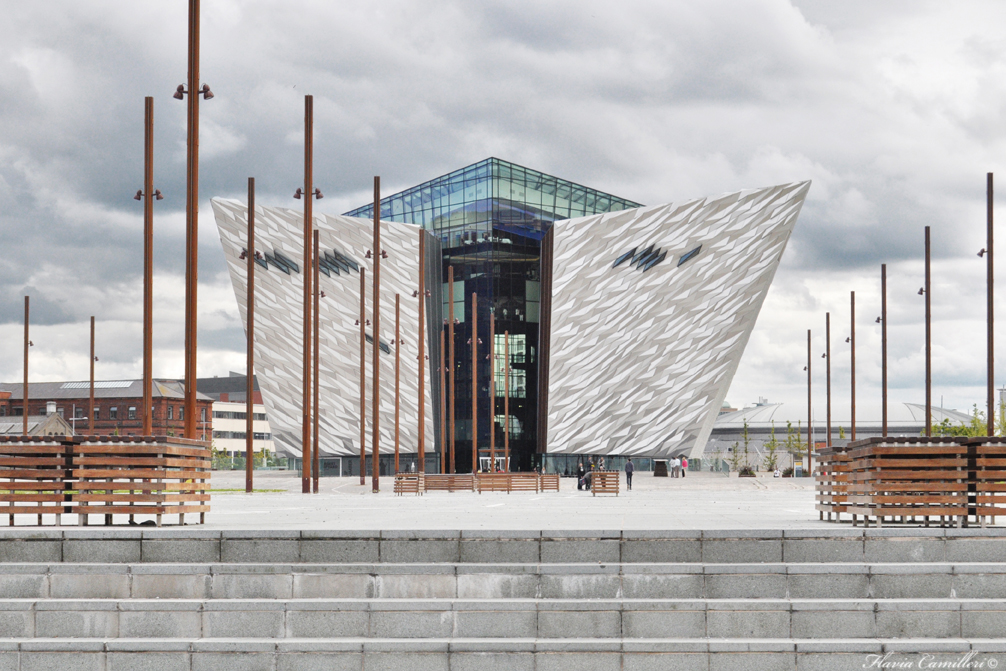
After the Tragedy...a new icon for the city - Titanic Belfast

On 31st March 2012, 100 years after the sinking of the Titanic, the Titanic Belfast was opened, on the heads of the historical Olympic's and Titanic's slipways.

The Titanic Belfast was part of the reinvention of the site which began with the new millennium and was also driven by the fact that several visitors were coming from all over the World interested in see where the Titanic was built.

This was the beginning of the new Lagan Village masterplan and of the new Titanic Quarter.

Titanic Belfast, with its jutting prows, became another icon of the city. It hosts a visitor centre which guides the visitors through the story of Belfast and the one of the Titanic. Info here http://titanicbelfast.com/

Titanic Belfast, Belfast 2015

Titanic Belfast, Belfast 2015
On the picture below, a photo taken from a descriptive board shows the Titanic Quarter one hundred years earlier.

Titanic Quarter, Belfast 1911 (photo taken from the descriptive board)

Sunday, 6 March 2016

Thomas Andrews

This is a story. A sad story which is shined by courage. The story of a man who was not only intelligent, but also brave and generous, and in front of the tragedy, he chose to save others' life.

He was the young Thomas Andrews and the tragedy is that of the Titanic.

Thomas Andrews was the nephew of William James Pirrie*, the chairman of Harland and Wolff. In 1989, at the age of 16, Andrews left school to begin his apprenticeship at Harland and Wolff in Belfast. His apprenticeship lasted 5 years and during this period he gained experiences in all the sectors of the company. The last 18 months of these 5 years, were spent in the Drawing Offices where he could shown his skills in mechanical engineering and construction, together with his leadership ability.

In 1901, at the age of only 28, Andrews became the manager of the construction works, and also member of the Institution of Naval Architects.

In 1907, he was appointed managing director and head of the drafting department at Harland and Wolff.

In July 1908 the White Star Line, one of the Harland and Wolff's largest consumer, commissioned the company to build three new liners, the Olympic, the Titanic and the Britannic.

Andrews carefully supervised the design of the three ships (which was the same) making sure that were in optimal working order. Unfortunately, not always his suggestions were followed, as that one of supplying the ship with 46 lifeboats (instead of the 20 it ended up with).

He also headed the Harland and Wollf's "Guarantee Group", a group formed by the best 9 men of the company whose task was to accompany each vessel in its maiden voyage, that is in its first journey, to see that all went well and to spot any necessary improvements.

Under this role, on 4 April 1912, Andrews went on board of the Titanic for her maiden journey, leaving from Belfast to Southampton. From Southampton, on 10 April 1912, the Titanic with Andrews on board left for her first trans-Atlantic to New York. During the voyage, Andrews took notes on various improvements he felt were needed, primarily cosmetic changes to various facilities. However, on 14 April, Andrews remarked to a friend that Titanic was "as nearly perfect as human brains can make her."

On Sunday 14 April 1912, at 11:40 pm, the Titanic struck an iceberg. Andrews was in his stateroom, planning changes he wanted to make to the ship, and barely noticed the collision. Captain Edward J. Smith called Andrews to help him examine the damage, who conducted a rapid tour of the ship to assess the damage and concluded that the ship would have inevitably sunk.

At 12.15 am, the order was given to start filling lifeboats. Andrews known that he would have not had more than one hour, and he spent all the remaining time ensuring the survival of the passengers. Several survivors testify to have met or spotted Andrews several times. Fully aware of the short time the ship had left and of the lack of lifeboats space for all passengers and crew, he continued to urge reluctant people into the lifeboats in the hope of filling them with as many people as possible.

Shortly before the sinking, Andrews retired to the first class smoking room: at approximately 2:10 a.m., ten minutes before the Titanic fully sank into the Atlantic, he was seen by John Stewart, a steward on the ship,  standing alone staring at a painting, "Plymouth Harbour", above the fireplace, arms folded over his chest, his lifejacket lying on a nearby table.

At 2.19 am the ship split in two, two hours and forty minutes after striking the iceberg, and began its descent into the ocean.

That night, Andrews died with other 1521 persons, and his body was never found.

"Plymouth Harbor" by Norman Wilkinson. The painting depicted the
entrance to Plymouth Harbor, which Titanic had been expected to visit on
her return voyage. The story of Andrews being last seen in front of this painting
has been however several times disproved by other testimonies who said to have seen
Andrews in other locations. Photo of the painting taken here.  
Below a short video who tells you more on the courage of Thomas Andrews. To read more about his life, there is also Wikipedia.


*William James Pirrie enterd the Harland and Wollf in 1862, at the age of 15. An excellent worker and manager, he was made partner of the company in 1874, at the age of 27, and when Harland died, in 1895, Pirrie became Chairman of the company, until his death in 1924.


Slipways No. 2 and 3

Slipways Nos. 2 and 3 are the slipways where the White Star Liners Olympic and Titanic were built. To accommodate the new liners, Harland and Wollf re-engineered three existing slipways in these two larger which could accept the huge hulls. The works for the Olympic started in December 1908, and those for the Titanic in March 1909.

Nowadays, slipways Nos. 2 and 3  form a lasting memorial to those who died, and to those who survived, the disaster.

Slipways Nos. 2 and 3 in the Titanic Quarter
(photo taken from the descriptive board)

Slipways Nos. 2 and 3 in the Titanic Quarter, now a lasting memorial
of the tragedy. Belfast, 2015

Sunday, 28 February 2016

Samson and Goliath

Today we speak of Samson and Goliath .....no no, do not worry....you are still in the blog dedicated to Ireland and not in any religious blog... ;)

Samson and Goliath are the names of the magnificent yellow twin shipbuilding gantry cranes situated in Queen's Island. They have been built in 1969 and 1974 when the "Harland & Wolff" was one of the largest shipbuilders in the world.

The "Samson and Goliath" shipbuilding gantry cranes, Belfast 2015 


Notwithstanding shipbuilding has ceased in Belfast (the last ship launched at the yard was in March 2003), the twin cranes are still (2015) kept in working order and used for heavy lifting by Harland & Wolff in its other activities.

The Samson and Goliath gantry cranes are scheduled as historic monuments under Article 3 of the Historic Monuments and Archaeological Objects (Northern Ireland) Order 1995.
 
Nowadays, the cranes stand sentinel over the city of Belfast and became one of its main symbol.
 
One of the "Samson and Goliath" shipbuilding gantry cranes standing
as sentinel over the city of Belfast, Belfast 2015.

And now some technical details: Goliath stands 96 metres tall, while Samson is taller at 106 metres (348 ft). Goliath, the smaller of the two sits slightly further inland closer to Belfast City.

Each crane has a span of 140 metres and can lift loads of up to 840 tonnes to a height of 70 metres, making a combined lifting capacity of over 1,600 tonnes, one of the largest in the world. Prior to commissioning, the cranes were tested up to 1,000 tonnes, which bent the gantry downwards by over 30 centimetres.

The dry dock at the base of the cranes is the largest in the world measuring 556 m × 93 m.

You can find these information and more in Wikipedia.

One of the "Samson and Goliath" shipbuilding gantry cranes, Belfast 2015 

Sunday, 21 February 2016

Queen's Island and the birth of the "Harland and Wolff"

Queen's Island is an island..as suggested by the name...and to be more precise, it is an artificial island :)

The material which forms this 17-acre island was removed during the steam powered dredging process finalised at the formation of a low water channel going from Dunbar's Dock to the River Lagan (1841). This was planned to allow large sailing ships to access the port, which before was difficult because of the shallow and sinuous nature of the River Lagan.

The norther part of Queen's Island was dedicated to leisure and resort, and it was also known as the "People's Park". Equestrian performances, concerts, and finally as the most important event, the "Victoria Fete", were all held there. The construction of an elegant glass-iron-wood Palace (1851), an aquarium (1856) and the first zoo in Belfast (1859) gave to the island a big popularity as resort. In 1864, a fire broke out and destroyed the Palace.

The South and East parts of Queen's Island were instead maritime industrial areas. With the completion in 1849 of the Victoria Channel, a deep water cut in the Belfast harbor that allowed larger ships access to the port, trade from and to Belfast also increased drastically.

The first iron shipbuilding yard was opened in 1853 by Robert Hickson who employed the designer Edward Harland as general manager. In 1858, Harland bought the business from Hickson for £5.000 and three years later he went in partnership with his personal assistant, Gustav Wolff, forming the Harland and Wolff.

In the years later, site reclamation was performed with the construction of new shipbuilding facilities and the completion in 1867 of the Hamilton Graving Dock. The Harland and Wolff used the new facilities to launch many of the ships they built for the White Star Line.

Nowadays, Queen's Island is a residential and business area, and again a leisure centre with its Odyssey Complex (arena, cinema, bowling, restaurant, bar, etc.)

Queen's Island (photo taken from the descriptive board).
Queen's Island, Belfast 2015

Saturday, 13 February 2016

The Big Fish of River Lagan

If you have read the post on the Lagan Weir, you should then know that the environmental restoration project carried out in the area resulted also in the rebirth of the river as wildlife habitat, with salmons and common seals back to swim in the River Lagan's waters.

To celebrate this success, a sculpture was commissioned in 1999 to local artist John Kindness.

He realised a 10 meters long salmon, with the outer "skin" composed by ceramic blue tiles decorated with texts and images relating to the history of Belfast.
 
More info in the following links:
 
The Big Fish, Belfast 2015
The Big Fish in Donegall Quay, Belfast 2015
The Big Fish, Belfast 2015
 

Lagan restoration project and Lagan Weir

The biggest river in Northern Ireland which runs for 86 km before entering the Belfast Lough is the River Lagan.

What attracted me of this river and of the area along its banks (called Laganside and measuring 140 hectares) is the environmental restoration project which transformed an abandoned polluted area around a tidal river in an area which now plays a vital role in the life of Belfast city.

The main opera was the Lagan Weir, completed in 1994, which served as river dredging and which has an aeration system: this allowed the control of the water level and the improvement of the water quality.

The photos below (taken from the explicative boards in the area - for this Belfast is very visitor-friendly...you can find descriptions of monuments, buildings, streets, etc. all around the city) show how the Lagan River was before the restoration project.


Before the construction of the Lagan Weir the water level was varying 3 meters between low and high tide. During low tide unsightly and smelly mud flats were exposed. The weir now allows a constant minimum water level upstream.

The over £1 billion of investments consisted also in the dredging of the river, in the removal of contaminants and in the installation of a riverbed aeration system to mix the saline and freshwater upstream and to supply oxygen for the biodegradation of contaminants.

Nowadays the river does not serve only as central point of a lively Belfast, but the restoration project resulted also in the rebirth of the Lagan river as wildlife habitat. Visitors of the river are for example the Common Seals and salmons (who were reintroduced in 1991). Notwithstanding I have not seen any of those :( :(, below is the photo of a nice seal nosing around the river bank (photo taken from the descriptive board).


Last but not least, I am happy that the Lagan Weir was jointly funded by the Laganside Corporation and the European Commission.

And now...(I know you are waiting only for these ;) :P) ...MY photos! :)

Lagan Weir, Belfast 2015

Lagan Weir, Belfast 2015

Lagan Weir, Belfast 2015

Sunday, 31 January 2016

Albert Memorial Clock

 
12.21 am
 
Albert Memorial Clock, Belfast 2015

Belfast has it own leaning tower, the Albert Memorial Clock, located on the East of High Street.

It was built in 1865-1869 for commemorating the death of the husband of Queen Victoria, Prince Albert, who died in 1861.

12.26 am

Albert Memorial Clock, Belfast 2015

This tower is not leaning as much as the famous Italian Pisa's Tower, but anyway over the years it has accumulated a list of 1.25 metres off the vertical towards South.

12.35 am

Albert Memorial Clock, Belfast 2015

A multi million pound restoration project carried out in 2002 has allowed the stabilization of the foundations and donated to the tower the original Victorian splendour.

7.08 pm


Albert Memorial Clock, Belfast 2015
The tower is 35 meters high and constructed mainly in sandstone. It was built on wooden piles on reclaimed, marshy land around the river Farset, conditions that caused the subsidence of its foundations.

 7.10 pm
 

Albert Memorial Clock, Belfast 2015
People from Belfast comment that "the old Albert has both the time and the inclination".

Saturday, 30 January 2016

St. Anne's Cathedral in Belfast

 
St. Anne's Cathedral is the heart of the Cathedral Quarter.

Cathedral Quarter, Belfast
The work for its construction began in 1899 and continued for eighty years. The architectural style is Irish Romanic.

The façade of St. Anne's Cathedral, Belfast 2015
The interior of St. Anne's Cathedral, Belfast 2015

One of the most interesting things of this church is the marble labyrinth in the central area of the floor at the West End. Its single, non-branching path represents the journey of life. Following the white route (virtue) leads the pilgrim to the Altar, that is to the Salvation. However the black route leads nowhere.

The marble labyrinth of St. Anne's Cathedral, Belfast 2015

Thursday, 21 January 2016

The Writers' Square

Today the post should have been dedicated to the St Anne's Cathedral of Belfast, located in the Cathedral Quarter, the photos are already ready...but well, in am not in the mood of writing and then tonight I let who is better than me with words to speak .

We are in the Writers' Square, in front of St Anne's Cathedral. The square pays homage to Belfast's rich literary tradition, with quotation about Belfast by famous local writers carved into the stone underfoot.

Instead, my quotation of today is: "Love your passions, it is the only way you have to cope with the brutalization of those who don't love anymore."

"And that night there was a great reast in Cair Parval,
and revelry and dancing, and gold flashed and wine flowed,
and answering to music inside,
but stranger, sweeter, and more piercing came the music of the sea people."
C.S. Lewis (1898-1963)

"See Belfast, devout and profane and hard,
Built on reclaimed mud, hammers playing in the shipyard,
Time punched with holes, like a steel time sheet, time
Hardening the faces, veneering with a grey and speckled rime
The faces under the shawls and caps
This was my mother-city,
these my paps."
 Luois MacNeice (1907-1963)

"From the night of moving shadows
 To the sound of the shipyard horn;
We hail thee Queen of the Northland
We who are Belfast born."
Thomas Camduff (1886 - 1956)

"Made when the world was fashioned,
Meant with the world to last,
The glorious face of the sleeper
That slumbers over Belfast."
Alice Milligan (1865 1953)

"On his way back to the College he wandered about the city
learning the names of the street: Oxford Street, Victoria Street,
Cromac Street, Durham Street, Townshend Street, Carlisle Circus,
and he thought of the island names - Lagavristeevore, Killaney, Crocnacreeva,
Carnasheeran, Crocaharna - words full of music
and he said them out aloud to himself as he went along."
Michael McLaverty (1907 - 1922)
 
"I should have made it plain that I stake my future
on birds flying in and out of the schoolroom window,
on the council of sunburnt comrades in the sun, 
and the picture carried with singing into the temple."
John Hewitt (1907-1987)

"Ireland is a very lovely country.
Indeed, there is only one thing wrong with it,
and that is that the people that are in it
have not the common-sense to live in peace
with one another and with their neighbours."
Robert Lloyd Praeger (1865 - 1953)

"Here's yellow - man*, an' tuffy sweet,
Girls will ye taste or pree it;
An aul' wife crys gaun through the street,
Boys treat veir sweethearts tae it."
Robert Huddlestone (1814 - 1887)
 
Do mhíle fáilte a Bhanríoghain Éire,
Go cathraigh éigseach chríche Uladh.
Mas fuar síon ar mhullaigh a sliabh,
Is grádhach díolos croidhe a bunadh.
(trad: 1000 welcomes, Oh Queen of Ireland,
To the poetic city of the land of Ulster.
If cold be the wind on its mountain-tops,
Its people’s hearts are warm and loyal.)
Roibeard Mac Adhaimh (1808 - 1895) 
Irish motto for Queen Victoria on her visit to Belfast.
 
 
Yelloman is a chewy toffee-textured honeycomb produced in Northern Ireland


Monday, 28 December 2015

No drink please

Free alcohol zone, Belfast 2015
Ireland may be very famous for its beers, whiskies and other alcoholics...

And probably also for its drinkers..:).. and I was wondering what they have done to lead Ireland introducing free alcohol zones...

Then I searched in internet...and from various posts and forums (eg, from bbc) I found that the main problem was/is that of young people getting around in group, drunk, noisy and becoming violent...opsss...now that I remember this was the same problem in Glasgow 10 years ago...well, fortunately I have not met such kind of groups of young people during my stay in Belfast, I do not know if because of the areas where I was or because the free alcohol zones result really in safer places...

The reduction of underage and on-street drinking was in fact the aim of the introduction of the free alcohol zones. Anyone over the age of 18 caught by the Police Service of Northern Ireland (PSNI) drinking in a specified non-drinking area may be prosecuted and could face a fine of up to £500. Anyone under the age of 18 caught drinking will have their details passed on to the PSNI Youth Diversion Officer and have a letter sent to their parents.

If you look on the internet, there are also other cities that have applied this rule, both in UK and in the far Australia and New Zealand.

I am thinking now if a similar regulation would be applied in Rome, in area such as Trastevere or Campo dei Fiori...well, the last time that I was in Trastevere on Saturday night I did not feel very safe...so maybe..

Free alcohol zone, Belfast 2015

Tuesday, 15 December 2015

Harland and Wolff

The Harland & Wolff is the company that built all the ships of the White Star Line, including the RSM-Titanic, this last one between the 1909 and 1911.

Close to the new Titanic Belfast, it is possible to see the former drawing offices of the company. The interiors of these two offices have a cathedral like atmosphere, are ornately decorated and efficiently naturally laminated. In these buildings the projects of the three sister ships, the Olympic, the Titanic and the Britannic were implemented and the detailed designs prepared.

In the first photo, the external wall of the offices. In the second photo, probably a room used as technical room or bathroom.

The Harland & Wolff's offices, Belfast 2015


Saturday, 5 December 2015

Titanic Belfast

One of the things that I have discovered being in Belfast was that the famous - for, ahime! :(, tragic reasons - Titanic was built here.

The initial part of the slipway where the Titanic was built is today occupied by the Titanic Belfast, a multimedia centre dedicated to the history of Belfast and of the famous ship.

The centre was open in April 2012, in the occasion of the centenary of the shipwreck.

I did not enter in the centre (have I already told you that I get bored in museum?), but I enjoyed a couple of hours in taking pictures there and around. Lots will come soon here! :)


Titanic Belfast, Belfast 2015

Wednesday, 18 November 2015

Summer of 69

I said already that for passing from the Republican area to the Unionist one, I had to make a kind of "U" as the Peace Line was closed.

When you arrive to the Unionist area, around Shankill Road, and if you come from the Republican area of Falls Road, then the impact is significant. You have the impression to be completely in another country, no matter if actually you are in the same city and just few km away.

British flags waves everywhere, from building and across roads...with more showiness (under my point of view) than the Irish ones in the area around Falls Road.

Hopewell Avenue, Belfast, 2015
The summer of the 1969 was the beginning of the Troubles, as consequences of tensions amongst Republicans and Unionists based mainly on inequalities in housing allocation and problems in voting systems.

Conflicts and attacks on homes saw the displacement of several Catholic and Protestant families. This mural remembers that period.

Tuesday, 17 November 2015

Remembering Glasgow - the Divis Tower

Divis Tower, Belfast, 2015
At the time I was in Belfast I decided to shoot this building as it remembered me the big tall buildings in the Glasgow area close to the University. Once I visited one, when I was looking for an apartment, and I remember that the feelings were not nice. These big housing towers are far from the skyscrapers that one can find in the rich financial districts.

These are mainly poor housing build probably with the aim to accommodate a lot of people at low cost.

And each of these building brings with them the sadness reflected in their style....well the Divis Tower is much better than the Glasgows's ones....

This one in Belfast - the Divis Tower - was built in 1966 as part of the now-demolished Divis Flats complex. The tower has 20 floors (oh my God, I remember taking the small lift in the tower of Glasgow and the floors never ended....and then you are up there, but no, no nice view, you are in this small flat and I really felt uncomfortable) and it is 61-metre tall.

The housing complex had 850 flats and was housing 2400 residents (well, and average of almost 3 people per flat...)....the name was given due to the nearby Divis Mountain.

Due to the IRA activity in the area, British Army constructed an observation post on the roof in the 1970s and occupied the top two floors of the building. During the Troubles, access to the post was possible only via helicopter. In that period, the tower was the location of conflicts between Republicans and Unionists.

When the IRA declared to end the armed campaign, the Army decided to dismantle the observation post. Now the post has been converted in residential properties.

Interesting video of the Divis Tower with interview of the architect Frank Robertson, some old photos and more info here.

Tuesday, 10 November 2015

The Peace Line #2

"We have to talk about liberating minds as well as liberating society"
Angela Davis
 
"It is easier to build strong children than to repair broken men"
Frederick Douglass 

"The most potent weapon in the hands of the oppressor is the mind of the oppressed" Steve Biko
  
"As I would not be a slave, so I would not be a master. This expresses my idea of democracy" Abraham Lincoln
Northumberland Street, Belfast, 2015
"For to be free is not merely to cast off one's chains, but to live in a way that respects and enhances the freedom of others" Nelson Mandela
  
 "The worker is the slave of capitalist society, the female worker is the slave of that slave" James Connolly
  
 "Why should they ask me to put on a uniform and go ten thousand miles from home and drop bombs and bullets on other innocent brown people in Vietnam while so-called Negro people in Louisville are treated like dogs and denied simple human rights?" Muhammad Ali
  
 "I HAVE A DREAM...black men and white men, Jews and Gentiles, Protestants and Catholics, will be able to join hands and sing in the words of the old Negro spiritual: Free at last! Free at last! Thank God Almighty, we are free at last!..." Martin Luther King

Saturday, 7 November 2015

The Peace Line

There are still walls which divide people.

Walls built in name of a religion, or of a political state, or to avoid people entering those that we believe being our own territories....

I remember  the 9th of November 1989 so well: the day when it was decided to open the Berlin Wall. After few days I would have been 14: thinking to the past, I am surprise how much this event touched me...I still have the journal article of that day.

Belfast is still divided.

"Peace Lines" were begun to be built at the end of the 60's, when the beginning of the Troubles increased the tensions between Catholics and Protestants, respectively pro and against Northern Ireland independence. The aim was to decrease the violent attacks between the two parts.

In West of Belfast, the "Peace Line" separates the area of Falls Road, where the catholic Republicans mostly live, to the area of Shankill, where the Unionists of protestant religion live.

The walls have gates (sometime controlled by the police) which allow the passage from one to the other side. They are open during daylight but closed at night.

All the murals shown up to now here are Republican and located in the area of Falls Road. I arrived at the Peace line at 6:30 pm.: the gates to pass to the Shankill area were closed...I had to come back almost to the centre of Belfast to make a kind of "U" route for arriving to the other side....

Discussion on the removal of the "Peace Lines" began in 2008, but a study carried out in 2012 by the University of Ulster showed that the majority of the residents believe that the peace walls are still necessary because of potential violence. In May 2013, the Northern Ireland Executive committed to the removal of all peace lines by mutual consent by 2023 (read the news).

More about the "Peace Lines" in Wikipedia.
I HAVE A DREAM
Northumberland Street, Belfast, 2015
"...And when this happens, and when we allow freedom ring, when we let it ring from every village and every hamlet, from every state and every city, we will be able to speed up that day when all of God's children, black men and white men, Jews and Gentiles, Protestants and Catholics, will be able to join hands and sing in the words of the old Negro spiritual:
          Free at last! Free at last!
                Thank God Almighty, we are free at last!..."
Martin Luther King - Washington, 28th of August 1963

Wednesday, 4 November 2015

Salvador Allende

Placed in a historic transition, I will pay for loyalty to the people with my life.  And I say to them that I am certain that the seeds which we have planted in the good conscience of thousands and thousands of Chileans will not be shriveled forever.  They have force and will be able to dominate us, but social processes can be arrested by neither crime nor force.  History is ours, and people make history.
Colocado en un tránsito histórico, pagaré con mi vida la lealtad al pueblo.  Y les digo que tengo la certeza de que la semilla que hemos entregado a la conciencia digna de miles y miles de chilenos, no podrá ser segada definitivamente.  Tienen la fuerza, podrán avasallarnos, pero no se detienen los procesos sociales ni con el crimen ni con la fuerza. 
La historia es nuestra y la hacen los pueblos.
Salvador Allende, Santiago de Chile, 11 September 1973
(ref:http://mrzine.monthlyreview.org/2006/allende110906.html)
On the 11 of September 1973 the Chilean coup d'état took place during the Presidency of Salvador Allende. When the troops surrounded the presidential palace, Allende gave his last speech to the Chilean people with a phone call to a local radio station. Later that day, he killed himself, according to investigations conducted by a Chilean court with the assistance of international experts.
The speech is the inspiration of this mural. At the centre of the mural is the portrait of Allende, and behind him is the symbol of the Unidad Popular coalition with whose support he was elected in November 1970 President of Chile. He has been the first Marxist to be democratically elected as president of a South American country.
Northumberland Street, Belfast, 2015